In January 2024, come up with a new resolution mechanic for a TTRPG and give it a name.
This needs a name so I thus name it “D6.5 Resolution”.
Pre-roll process
Whenever a character wants do so something, and the result is in doubt, the GM calls for a roll.
The character’s player states their character’s action and the intent of the action clearly.
The GM says whether they think success would be likely or unlikely. They might also use words like ‘very’ or ‘slightly’.
If the player doesn’t agree, then talk it out. Ensure that everyone’s understanding of the scenario is aligned.
The rest of this process can be hidden and done entirely by the GM, or open with player involvement. A hidden resolution relies on trust, whilst an open resolution invites collaboration.
D6.5 rolling process
The GM sets a target number from 1-5 and a d6 is rolled. Only if the result is over the target number then the action is successful.
Target Number
Likelihood of success
Probability of success
1
Very Likely
5/6
2
Likely
4/6
3
Even
3/6
4
Unlikely
2/6
5
Very Unlikely
1/6
If the GM wants to have degrees of success then they also roll a d3. The result can modify the success or failure to act as a critical result, or a limited result.
D3 result
Success
Failure
1
Limited success/success with a problem
Critical failure
2
No effect
No effect
3
Critical success
Limited failure/failure with a benefit
Analysis
I recently saw an rpg forum comment chain where folks were debating the merits and demerits of a particular game system. In particular, one poster was lamenting that a given system didn’t have degrees of success.
That particular debate struck me as rather silly. If you want degrees of success, I thought, just patch them on with a D3. Hence this mechanism.
I have used it to run Cosmos 2250 and Super Monster Friends. It works perfectly well for pseudo-star trek and pseudo-pokemon so it should work well for most anything.
It’s quick to use and returns you back to the conversation, and the GMs brain, which should together be your core game engine, with minimal issue.
The naming comes from the d6 and a possible additional d3, which is half of a d6. Hence D6.5
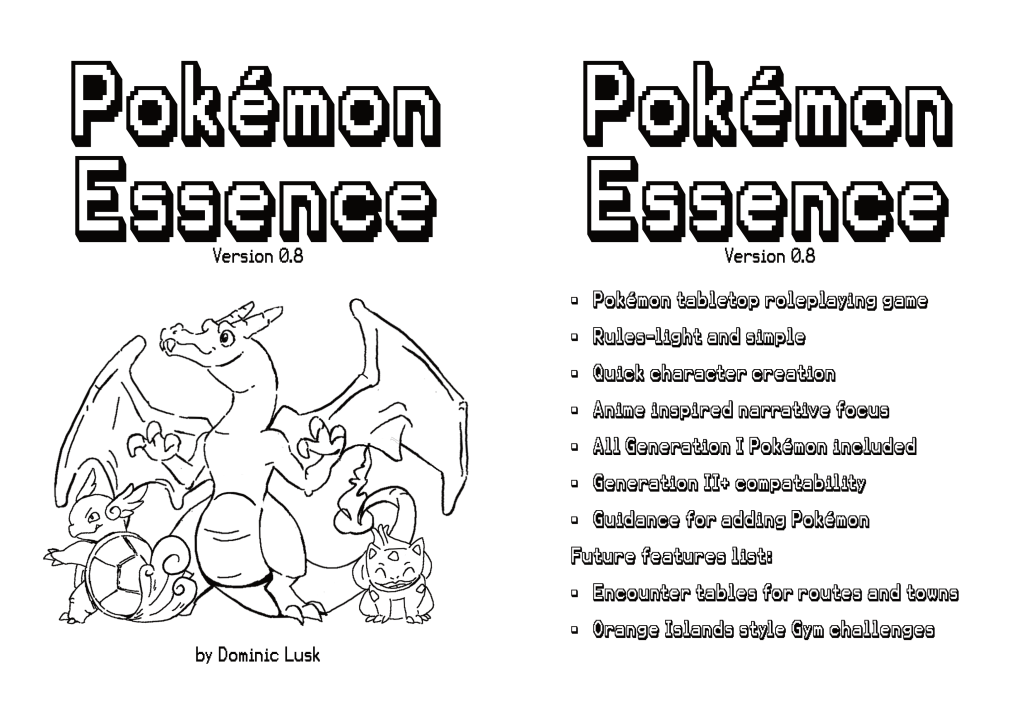
I’ve blogged before about pokemon style games. I released Pokemon Essence on itch.io and there are some posts from back in mid 2021 about legally distinct pokemon. Obviously old me was a fool and new me knows the best way to play a mon game. In the business, we call this personal growth.
Basic action resolution
If a mon can do something easily, then the GM narrates it how it easily does that thing.
If a mon cannot do something, then the GM narrates how it fails to do that thing.
If unsure then the GM chooses a target value from 2-6 and the player rolls a 1d6. If the player rolls equal or over the target value, then the mon is successful.
The GM chooses the target value after a discussion with the player about how good they think the mon is at the thing they are trying to do.
If the mon is really good but there is some risk then the target value can be a 2. If it is really bad but there is some chance of success then the target value can be a 6. If there is a 50-50 chance then the target number is a 4. Use 3 and 5 as target values for in-between cases.
Degrees of success action resolution
Roll as above, but also roll a d3 and look up the result on the table below.
Initial result = Success
Initial result = Fail
d3 = 1
Success with complication
Critical Fail
d3 = 2
No Change
No change
d3 = 3
Critical Success
Fail with a boon
Group world creation or GM world creation
Below I write in several instances that the table collaborates to create statements about the world. If you don’t want to do that, then don’t do that. The GM can do all that stuff in advance, but that takes prep time they might not have.
What is a ‘mon good at?
When a mon is encountered, look at the mon and write down some things that you think it would be good at. These are the mon’s aspects
Art by my friend Becca 3D. The mon is called Vineapple
Looking at Vineapple I would give it the aspects Verdant, Vine and Jaw. I would ask the players at the table if they had any other ideas. Maybe someone would suggest changing Jaw to Beak. We’d come to an agreement.
Then when Vineapple was trying to do something, use the aspects to decide whether there needs to be a roll and what the target value should be if there is a roll. If an aspect seems to powerful, discuss that at the end of the session. Edit the aspects as needed.
This system takes trust. Play with people you trust.
Some aspects, behavioural ones, are not obvious from just looking at a mon. Add those in when possible. Maybe the vineapple above gets the aspect Rage.
Below is an array of potential aspects – make them up as needed and don’t worry about their interactions or advantages – they will be reasoned out in play through the action resolution.
Fire
Water
Air
Earth
Tail
Beast
Soak
Hair
Horn
Tiny
Sound
Shovel
Pinch
Leap
Beast
Whimsy
Jaw
Cute
Tusk
Light
Verdant
Metal
Tech
Vile
Food
Slime
Ghost
Cannon
Shell
Fear
Tall
Heavy
Mount
Artificial
Filth
Chaos
Clever
Dance
Claw
Fog
Mon personalities
Whenever you encounter a new mon, the table comes up with 6 personality traits for that mon species, and the GM rolls to see which of those traits this mon has. If the mon is caught, roll a second time to generate a bonus trait. Try to make a spread of positive and negative traits, and try to use traits that are active not passive.
Use this webpage for a big list of personality traits if you need inspiration.
Acquiring mons and their Advancement
Mons can be caught/acquired/catalogued/allied only with their permission – otherwise they can resist the acquisition mechanism. When a mon is encountered a personality trait is generated – this trait must be satisfied in some way before the mon can be acquired.
Some of those traits can be appealed by fighting the monster, but not all of them.
The players can collectively decide if the trait has been satisfied sufficiently to allow for acquisiton.
Mons cannot advance/evolve/digivolve/morph until both personality traits have been simultaneously satisfied.
Battling Mons and other vs. rolls
When battling/racing/in-a-dance-off mons’ controllers (player or GM) declare their actions and the intent of those actions simultaneously. Those actions can be judged independently using the normal resolution mechanism, unless they are directly opposed, or would be resisted by the opponent.
For an opposed roll, decide which mon, if any, has the advantage.
If neither has an advantage, roll 2d6 with a result of 7 resulting in a draw, results of 2-6 resulting in a success for mon A and results of 8-12 resulting in success for mon B. The further away from 7, the greater the success.
If mon A has a small advantage, move the middle result to 8, with results 2-7 now giving a success to mon A.
If mon A has a moderate advantage, use 9 as a middle result, and for a large advantage, use 10 as the middle result.
If mon B has the advantage, reverse the middle result, so a small advantage for mon B would have a middle result of 6.
Try to make the results of mon attacks really grounded in the reality of the world, with tangible and specific effects.
If you need a more concrete mechanism for damage, use the one below.
Most mons can endure about 3 hits, though legendary/mythical/dynamaxed/evolved mons can endure 4 or 5 and pathetic/baby/lesser mons can endure 2 hits. For most results on the opposed role, a mon takes 1 hit, but if the difference between the result and the middle number is greater than 4, then it takes 2 hits. For non-opposed battle actions, use the degrees of success rules with a critical success resulting in 2 hits taken by the target.
When a mon is has taken all the hits it can, it is out of the fight.
Encounter system
Roll a d6, with results 1, 2, 3 leading to a common mon, 4, 5 leading to an uncommon mon and 6 leading to a rare mon. Roll another d6 with low results meaning that there is merely evidence of the mon and high results meaning that the mon’s location is obvious.
So for each area you need at least 1 common, 1 uncommon and 1 rare mon.
Humanity has encountered a lot of alien species since it first travelled to other worlds. The four most common species are chronicled below broadly from the most relevant to least relevant. Alien species can be broadly divided into the Human-esque and the Weird.
The Human-esque generally act in a similar way to humans but they will have one or more notable differences. They are generally bipedal and around human size, capable of producing human-like vocalisations and with the same range of sensory inputs as humans. In a TV show they would have prosthetics on their heads. Their stories primarily concern culture and ethics. All the species detailed below are Human-esque.
The Weird are truly alien species. For instance, giant spiders which communicate exclusively via vibration, semaphore and pheromone. Communication is difficult, and comprehension sometimes impossible. In TV shows they would be puppets (or CGI, but puppets always age better). Their stories are more fundamental, concerned primarily with the nature of existence and experience.
Orangu
The Orangu are genetically uplifted Orangutans. They are kind, naive and curious.
About 50 years ago, it was discovered that a rogue group of scientists on a far flung human zoological colony had repeatedly experimented on captive mammalian species, endeavouring to create a new sentient species. Only one new species was viable – the Orangu, a modified Orangutan with broadened intellectual capacity, edited vocal cords and a more humanoid gait.
First Generation Orangu are the immediate results of the scientific experiments. They experienced well-intentioned but definitively immoral enslavement by their creators. Second Generation Orangu is somewhat improperly used to describe any Orangu which is not First Generation. They were born into freedom, but often grew up in curated and sheltered environments.
Orangu have a young and unstoried culture, which they see as both a blessing and a curse. The kind-nature of Orangu has made them well-liked by Humans. They are few in number but their curiosity drives them to explore and engage with the world around them. The Orangu cast Humanity in a new light, which caused the creation of The Charter of the Rights of Persons, a total rewrite of the much-amended ancient Declaration of Human Rights.
Orangu names are incredibly varied, as they have no longstanding cultural traditions of their own to draw from.
Jupiter Armstrong
Charlton Heston
Wendigo Frustum
Suriawati
Thaveen
The Thaveen are earnest, enthusiastic and obsessive.
The Thaveen are a human-esque species with wrinkled earth-toned skin and drooping ears. Adolescent Thaveen sample from as broad a range of experiences as possible. Their adulthood begins the moment they find and declare their one true passion. They rename themselves, creating for themselves their proper, adult name. They throw their heart and soul into their passion, obsessively. When a Thaveen hears about someone else’s passions or interests, they engage heartily and encourage earnestly. For a Thaveen, the purpose of life is the pursuit of your passion.
The Thaveen Mandate is run by the Admins, Thaveen who have a passion for organisation, politics and bureaucracy. Thaveen society progressed rapidly from the moment agriculture was invented, due to the guiding hand of the Admins. They had writing before metalworking, a world government before industrialisation, and had eliminated poverty before inventing digital technology.
The Thaveen Mandate have managed an outreach and research programme on Earth for over a generation. By sharing and guiding, they have contributed immensely to recent technological developments on Earth, in particular the development of the R-3 Relativity Drive. They are the closest that humanity has to a friend, but they are not military allies with the League. Earth is too far away, too technologically inferior, and too inexperienced. However, Thaveen officers are routinely found on Space Force starships.
Thaveen names start with a title, essentially a job description, followed by the name chosen by the individual upon attaining adulthood.
Admin Soaring Paperwork
Doctor Think and Thought
Engineer Crash Crash Bang
Sergeant Shoots First Shoots Later
The Legion
The Legion are a clone society that is an offshoot of the Thaveen. They are conformist, self-obsessed and grouchy.
A highly-irritable Thaveen geneticist called Legion Discrete dedicated his life to creating clones of himself so that he could enjoy communal activities without the bother of his fellow Thaveen’s quirks and idiosyncracies. He sequestered himself away on an isolated world and he was forgotten by Thaveen society, remembered only as a former eccentric colleague or dance partner.
A century later the Thaveen discovered that Legion Discrete had been successful, and a society of clones, called The Legion, had multiplied and flourished. Despite their shared cultural and technological history, the Thaveen and The Legion only have a cordial relationship. The Thaveen view The Legion as completely missing the purpose of life, and The Legion just think the Thaveen are annoying.
The Legion have exemplary genetic and cloning technology, but hire out to other societies to fulfil many of their needs. They have a very culturally regimented lifestyle. Everyone looks the same, enjoys the same food, is annoyed by the same habits and loves line dancing.
Legion names follow a variant of Thaveen naming convention, where first names are all Legion.
Legion Prime
Legion Isotope
Legion Foot First
Legion Stepback
Krix-ik
Krix-ik are a eusocial insectoid species with a caste system. They are mentally rigid and collectivist.
Krix-ik are divided into castes, where each caste has a unique morphology, and serves the colony in a specific manner. The Royal Caste are the only reproductively active Krix-ik and wield unchallenged executive authority – they have never been seen by humans. The Warrior Caste are aggressive and competitive. The Worker Caste are hardworking and deferential. The Thinking Caste, whilst more mentally flexible than the others, are coldly calculating.
All Krix-ik belong to a colony, which can span multiple sites across many star systems. The K’lok ‘ok colony has developed positive relations with the League of United Worlds, including trade agreements, a non-aggression pact and an officer-exchange program. Relations with other colonies are not as positive, and whilst apathy and mercurial interest are common, outright hostility is always a distinct possibility.
Krix-ik culture emphasises the good of the colony over individual outcomes, or even survival. Their culture is almost unrecognisable, consisting mostly of factual storytelling and parables, with no humour or romanticism. As their primary methods of communication are pheromones and stridulations, specialist equipment is generally needed for real-time conversations with humans. All Krik-ik know at least three languages: the common language; their caste language; and their colony language. Krix-ik have a lower level of neuroplasticity than most intelligent species and thus find it difficult to adapt their thinking.
Krix-ik names are poorly rendered in latin characters, not least as it is impossible to spell pheromones.
Cosmos 2250 is a science fiction game where players take on the roles of senior officers on board a starship.
This is a game in three parts: Setting, Systems and Scenarios.
Setting details known information about the world and is designed to orient any players of the game and align expectations.
Systems is a series of frameworks and procedures intended to aid in aligning expectations and understanding within the game group.
Scenarios relates the specific situations that the players will encounter.
Tone and Genre
This game has a positive view of the future of humanity. It is a future in which humanity has overcome great adversity and become a better version of itself. A future where humanity has an active ongoing effort to be the best version of itself.
This game is in the science fiction genre. It is full of alien cultures, strange technologies and philosophical dilemmas. Their purpose is to hold a mirror up to ourselves. They exist to create a shared narrative, and in doing so, examine what it is to be human. And they also exist because starships, aliens and laser guns are cool.
This game contains politics, diplomacy and elements of realpolitik. The players must balance their respect for other forms of life with the need to ensure their survival.
Humanity from 2000 – 2250
Humanity was facing a climate crisis, and failing to deal with it. Technological progress did not help. In fact, it was the cause of the crisis. Social innovation saved Earth’s inhabitants from themselves. From the worst of themselves.
A practical, viable, sustainable future was reached. Humanity proved to itself that it can achieve long lasting, positive global change. And it didn’t stop there.
Humanity eliminated poverty in a generation. Turned its focus on education for the next generation. And then it reaped the rewards of an educated population whose basic needs were satisfied.
Nuclear Fusion came next. And the reality-warping Relativity Matrix, the ticket to the stars. And then we met everyone else, and they met us.
Welcome to the Galaxy.
The League of Worlds in 2250
The League of Worlds is effectively the ‘space government’. Its primary purpose is to provide peace, safety and prosperity for its members, and as such it is responsible for all the normal governmental things: diplomacy; trade; immigration etc. However, individual planets, moons, space stations and so on all have their own polities and governments, which in turn have their own laws. Sometimes astronomical bodies are further subdivided into countries, as on Earth.
Matters of jurisdiction and legal precedence can therefore become rather complicated. There is a Court of the Rights of Persons, administered directly by the League, which acts as an ultimate arbiter on issues of individual rights amongst its members.
Most persons within the League are Human, and most of the population lives on Earth. There are large colonies on other planets in the Sol System and nearby systems such as Alpha Centauri and Tau Ceti. The further one travels from Earth, the colonies become less common and less populous. Orangu and Thaveen (including Legionaries) make up the vast majority of the non-human population within the League. The League has an active policy of fostering positive relations with other species, and there are a handful of associate members, which it hopes in time will gain full membership.
The League operates and maintains the Space Force, which it characterises as a ‘uniformed exploration and defense service’. The Space Force has many of the hallmarks of the militaries of old-Earth, and maintains high standards of professionalism and duty. However, it is not, first and foremost, a military. The Space Force has three core standing duties:
They didn’t stop there. Here are some more variants of chess that the kids made up.
Train Chess
Train Chess is played exactly like a normal game of chess, except that every 8 turns, a train steams through the middle two rows and destroys any pieces in those spaces. Normally the center four spaces are heavily fought over, but in this variant, you don’t want your pieces hanging around there.
Often players move pieces to the middle rows expecting that they can move them out before the train comes. Then the opponent pins their pieces there or wastes turns with easy-to-deal-with checks, until the pieces in the middle die.
If your king is hit by the train, you lose.
It sounds like a really dumb variant, and it is, but its also good fun and worth a try.
Double Chess
In Double Chess you set up two boards end to end, and set the pieces up at as normal at opposite ends. Now there are lots of spaces between each army, which inflates the value of the queen, bishop and rook, whilst decreasing the value of the other pieces. To rebalance the game, pawns can double move for their first turn and their second turn. Pawns also promote when they get to the end of their board, ie half way to the opposing army. Additionally, queens, bishops and rooks all have to stop their movement after crossing the seam between two boards. Knights are weaker than usual, and end up just being defensive pieces, or protecting pawns as they advance.
Double HP Chess
Set up the board as usual, except on each space, place two pieces instead of one. Each piece now has two HP, as represented by the second piece.
This game was an interesting experiment but it didn’t really work as intended. It becomes quite impossible to snipe pieces and everything becomes a bit of a meatgrinder. Unlike the other variants here, Double HP Chess didn’t get any repeat play.
Not every experiment works, but negative results are still results.
Double Train Chess
Combine Train Chess with Double Chess. Those important middle two rows where pawns upgrade and rooks, queens and bishops have to pause becomes very dangerous due to the train.
Battleship Chess
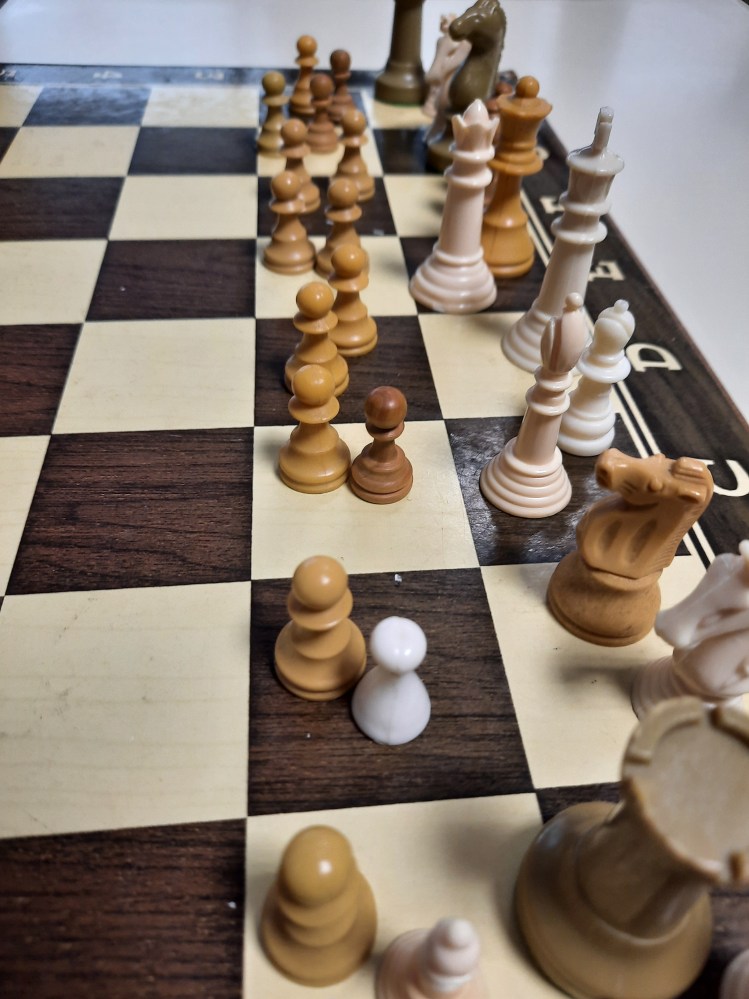
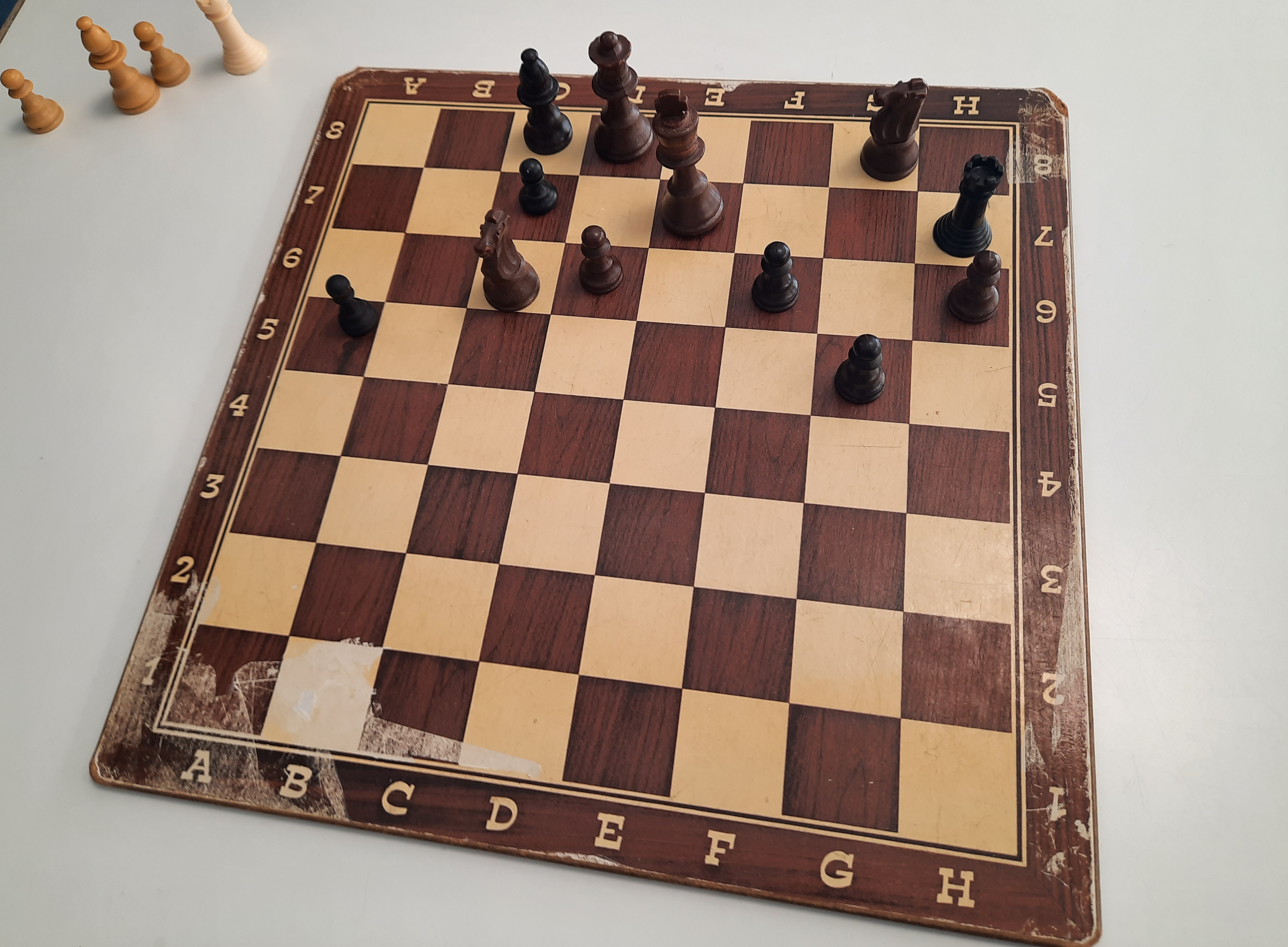
Not a variant that the kids invented, but one that became quite popular. Two players play back to back with a judge administering the game. Like in Battleship, players can only see their pieces and have to guess where the opponent’s pieces are. It’s often easy to know where pieces are, as they take your pieces, but hard to figure out what pieces they are. I never played this variant, but the players all found it to be very stressful and intense.
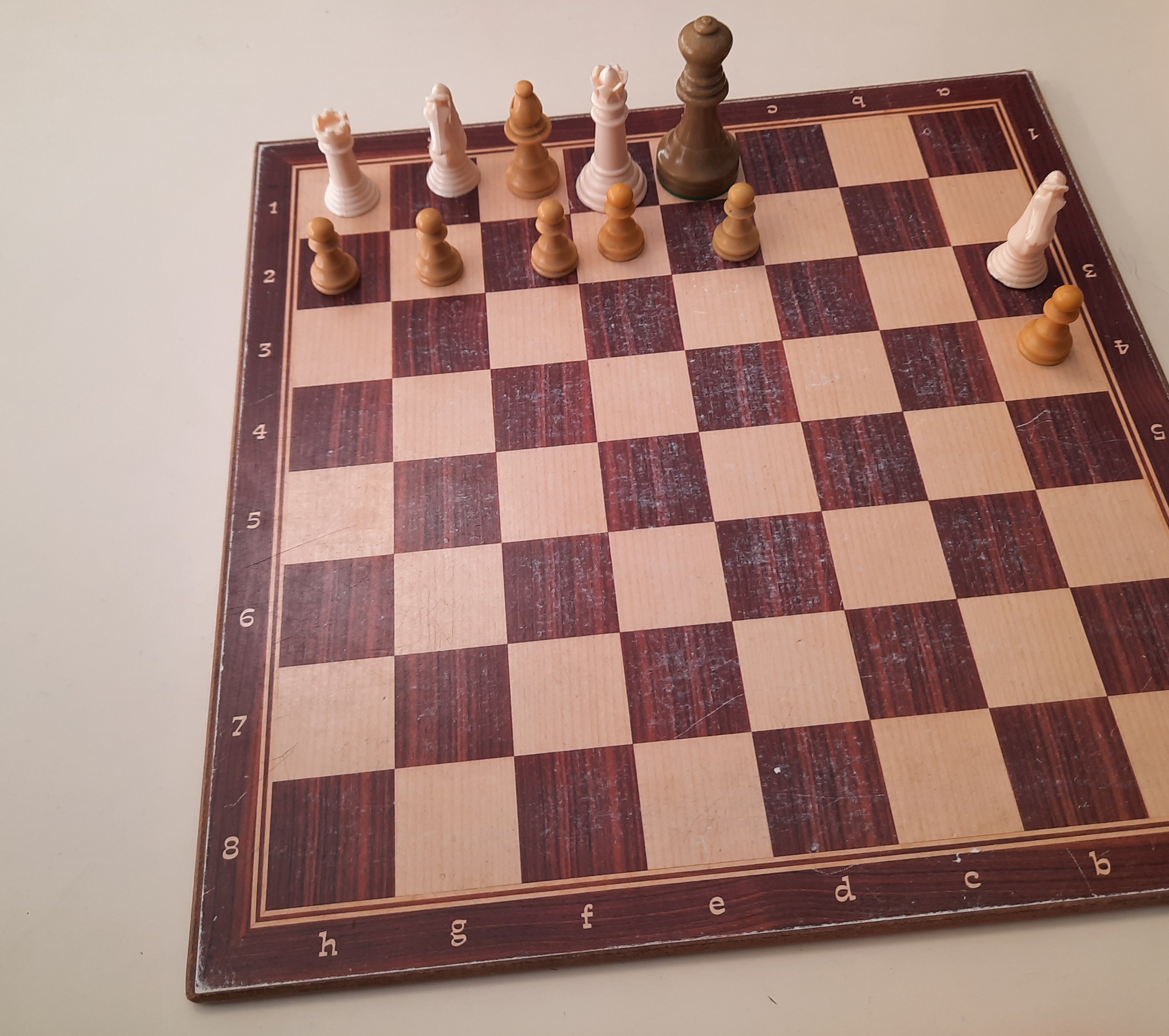
Black’s view in a game of Battleship Chess
And the opponent’s view.
Key Lessons
Sometimes the new rules didn’t work, but fun was had trying them out regardless
You can increase the longevity of a game by a lot with a little elbow grease
Nobody ever asked why there was a train steaming through the battlefield at regular intervals, they just accepted it because it was neat.
The next update, V0.81, will be the Viridian Region edit. It will include encounter tables, quests and locations for Pallet Town, Route 1, Viridian City, Route 2, Viridian Forest and Pewter City, including Pewter Gym, the Pewter Science Museum and the Pokémon School. Work is already in progress, check out a Route 1 encounter table below:
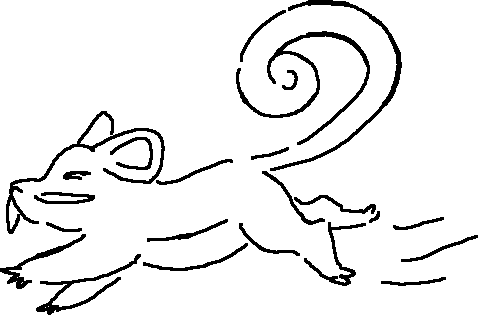
Youngster Ronny has a cowardly Rattata and wants some help teaching it the move Quick Attack.
A group of Rattata are eating from an abandoned picnic hamper. A Pidgey keeps swooping down, trying to take a sandwich.
A Rattata is gnawing at a can of tinned food, trying to open it
Schoolkids Shermon and Danny are having a very slow Pokémon battle, trash-talking each other all the while. Shermon has a Kakuna and Danny has a Metapod. They will trash-talk anyone who comes nearby too.
A nearby tree contains a nest with 2 fledgling Pidgey getting ready to fly for the first time. A Rattata is below the tree, waiting to pounce on them if they fall.
A young girl chases after a Pidgey which is flying overhead, carrying a pencil case.
I figure that if I can make a route with only Pidgey and Rattata interesting, the rest of Kanto has great potential!
The spell which returns Voldemort to corporeal form in chapter 32 of Harry Potter and the Goblet of Fire
Here are the other three best spells in Harry Potter.
I see crude images of monkeys, a multitudinous horde in infinite cartoonish variations.
The Unbreakable Vow
It’s a magically-binding promise from one wizard/witch to another, witnessed by a third.
If you break the vow you die.
It’s not clear from the fiction exactly why baddies aren’t using this to control people and are instead using the Imperius curse (a sort of mind-control), which can be repelled with training. Perhaps there is a component where the Unbreakable Vow just won’t work if the person making the promise is under duress. Of course, there are many types of duress, so even that doesn’t really explain it.
In Harry Potter and the Methods of Rationality, an excellent fan-fiction in which Harry is raised by scientist parents, the Unbreakable Vow permanently siphons off a bit of magical potential, which is a good explanation for why they are not constantly used. (I think its the magical potential of the person to whom something is promised that is sapped.) In fact, HPMOR is a fan-fic that adds and improves on the original – everyone is more competent and magic is used to its fullest extent with minimal plot holes.
The Unbreakable Vow has some similarities with Gaes in D&D.
What makes the spell so good is the potential for high-stakes drama.
The Fidelius Charm
You make something, typically a location, unfindable. Not just hidden, but unfindable. It can only be found by the person you designate as the Secret Keeper.
The Secret Keeper can tell other people the secret, so that they can find it, but those people cannot pass the secret on again. Its a mechanism for limiting the passage of secret information, and was used in the Wizarding Wars to keep The Goodies safe.
The roleplay juice here is centered on who you tell the secret to.
People who trust nobody can’t use it.
People who trust somebody are now beholden to that person.
That person is the weak link in your chain. Did you choose the right person?
It also feels similar to magic relating to the True Names of things. If someone knows your True Name, they have power over you.
Like the Unbreakable Vow, the Fidelius Charm provides some good roleplay possibilities, mostly relating to drama.
The Remembrall
I know it’s not an spell but the original list included a potion.
The Remembrall is a large marble-like ball with white smoke inside. If you’ve forgotten something, the smoke turns red.
As a kid I thought that the remembrall was a pointless gift. If I’ve forgotten something, at least tell me what it is!
As an adult I would love one. A magic item that means you never miss a deadline, you never forget to pay a bill – how many times have you rushed to barely complete something in time because you forgot about in entirely?
It’s a magic item of convenience – like a bag of holding.
In a ttrpg it would function as a mechanism to make sure that player knowledge stays aligned with character knowledge. As an excuse for the GM to aid the party without breaking the illusion of the game. It’s excellent not due to drama, but as a tool for the GM – in fact its a tool for the GM which the players probably think is a tool for them.
The DAQ Criteria
I’ve written before about the DAQ Criteria. We ask three questions of an ability (or item or spell etc.):
Is it Distinctive?
Is it Appreciable?
Is it Qualitative?
Spell
Distinctive?
Appreciable?
Qualitative?
The Unbreakable Vow
There is nothing else in the Harry Potter world which can do this, however the Imperius Curse comes close
Yes, if a character acted based on an unbreakable vow it would be an appreciable, noticeable moment in a game (or in the fiction)
Fundamentally the spell applies a rather unique quality to the target.
The Fidelius Charm
It is unique, there is no other stated mechanism for the protection of dwellings like this
Yes, escaping to a secret location and knowing that you are safe (unless betrayed) is highly appreciable
Very qualitative
The Remembrall
It is distinct, nothing else does what it does
This is debatable. We see in the fiction that Neville’s Remembrall reminds him that he’s forgotten something, but he can’t remember what he has forgotten. But if the players can remember what it was that was forgotten, then it would be highly appreciable.
Yes
All the best spells in Harry Potter are linked by their qualitative and distinct natures. They are also all appreciable, but I think this is a secondary design concern to the other two. The longer I have thought about the DAQ criteria, the more I’ve thought that it would be very hard to make something which is distinct, qualitative and yet not appreciable. Furthermore, I think that anything which falls into that category is still useful as a game element for setting tone.
Shilling for myself
I recently released Welcome to Camp Merlin, a short (6-12 session) game about a group of kids at a magical summer camp.
When I was designing the magic in Camp Merlin, aimed to make every spell fit the DAQ criteria. Here’s the spell list below:
Shape Shifting – take the form of an animal
True Slime – a perfectly lubricant, completely frictionless
True Glue – a perfect adhesive
Slowing – slows target
Ranged Shove – pushes back target
Power Walking – can walk up walls/on water
Perfect Replica – makes a reflected copy of an item
Truth Food – you must tell the truth while eating it
Sense Mind – sense, but do not read, nearby minds
Liquify – liquifies the target
Misremember – edits a memory
Mirth – forced laughter
These spells, combined with the qualitative tasks that must be completed to learn them, several unique monsters (with sub-tables to vary the encounters) and a dozen static encounters around Camp Merlin, compose 80% of the game. Very content-heavy, with some GM guidance and very light rules.
Essentially, a Matrix Game combines the tactical infinity of role-playing games with control of an ‘actor’ – a faction, organisation or entity – as would be expected in a strategy game. They align with the play worlds, not rules philosophy of the Free Kriegspiel Revival movement, meaning that setting, and the rules/expectations of the setting, takes precedence over a dense system of rules.
A cobbled-together primer:
Matrix Games from a professional military perspective mapsymbs
Open Strategy Game is a term that Chris McDowell coined to avoid confusion with all the other things that ‘matrix’ means. I think I prefer it.
My first Matrix Game
Michael over at lizardmandiaries put out a call for players of his Matrixhammer, a matrix game/Warhammer Fantasy mashup.
We played-by-post over discord and I fully recommend you go and read his play report of the game from a referee’s perspective.
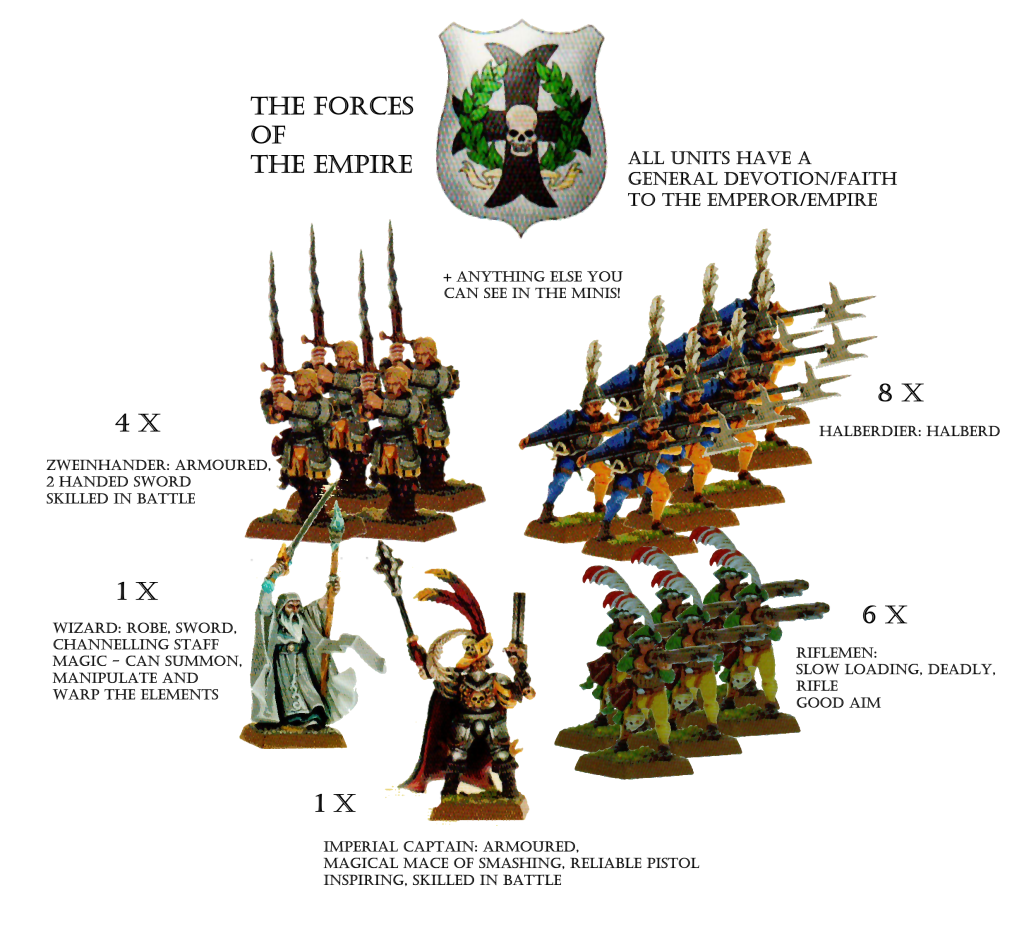
I was the Empire player with the forces below at my command.
My forces were camped at a hut beside a lake, it was midnight and an army of evil beastmen could be heard howling. They were about 2 hours travel away. My forces had to survive 6 hours until re-enforcements arrived.
Emotions are tricky
I want to preface everything I’m about to say by making something crystal clear – I think Michael did an excellent job of responding to the inputs that the other player and I gave him. I would absolutely play another matrix game run by him.
That being said, I did not fully enjoy the game whilst I was playing it.
There were some moments where my initial emotional reaction to the update was negative.
My rational brain had to step in and actively overrule those reactions.
After reading Michael’s play report, I am happy to say that my negative initial emotional reactions were founded on flawed premises, as my emotional reactions assumed certain things about the beastmen player’s actions that were untrue.
My after-the-event enjoyment of the game is much higher.
I think the root cause of my negative feelings was the high amount of hidden information in this scenario. Without prompting or suggestion from me, Michael seems to have identified it as an issue as well, as his next Matrixhammer scenario includes player arguments which are completely public for all terms. I think that is a good idea and would have mitigated the majority of the negative feelings I had, though he might not be doing it for that reason.
How I felt and what I thought throughout the game
Again, if you haven’t read Michael’s play report I recommend it. It’s a good read and it will provide useful context for the next section.
Turn 1
I was torn between setting up defensive positions and doing something sneaky. I went with sneaky and set up a flammable area nearby the hut, whilst keeping the area closest to the hut less flammable.
The Forces of The Empire make the are immediately near the hut fire-resistant, whilst making the area further outwards more prone to fire/the spreading of fire -The Halberdiers deposit dry leaves and twigs in the flammable area to act as good fire starters -The Riflemen deposit some powder in the flammable area for the same reason -The Wizard surges the lake water onto the fire-resistant area to dampen it
Turn 1
This was a success so I reasoned I would spend the next hour/turn fortifying, and the one after that triggering my sneaky fire trap.
At this point I was pretty pleased with myself for “doing a tactical infinity”.
Turn 2
I ordered fortifications on turn 2.
The Forces of The Empire make defensive preparations -The Riflemen make holes in the roof so they can shoot out from it -The Halberdiers use wood from the trees to create sharp spikes at the edge of the lake, facing towards the water -The Captain gives rousing speeches to each group of soldiers to steel their courage
Turn 2
I was told that my fortifications were a success, but that the horde had not got closer during the last hour.
…a very faint itchiness wafts briefly over your units skin. Your wizard senses some foul magics have occurred in the surrounding forests.
I inferred from this that a curse had been put on the surrounding area. I didn’t know what the curse was and wasn’t sure how to counteract it – I had a wizard in my forces, but he was tooled for elemental magic.
Turn 3
I decided that since I had another hour to prepare I would summon an air elemental who could take watch in case the pause by the beastmen forces was a trick.
The Forces of the Empire create an air elemental to act as a scout, and sends it to the edge of where they can see, within the flammable area -The Wizard summons the air elemental using his magic -The soldiers ensure its sanctity by singing hymns and prayers of the Empire -The Captain takes the plumes from the Halberdiers and gives them to the air elemental, so it can drop them as a signal if it sees any beast men
Turn 3
I found out that there was a large force of beastmen to my right and a smaller force to my left, and that they had started burning the forest. A helpful map was shared.
Turn 4
I decided that I would try to catch a large portion of the attacking force in my fire-trap. So far my emotions had been steadily positive.
The Forces of the Empire attempt to catch attacking the beast men forces in the flames. If they can split them by trapping some beastly forces with them on the inside of the fires (that is, in the flame-resistant area around the hut) whilst keeping most out then that is a bonus. -The Wizard keeps the flames at back until the right moment, then surges them forward -The ground is prepared for fire with powder and dry material, so it should spread quickly to the attacking beast forces -The air elemental will also keep back the flames before surging them on by adding air as fuel
Turn 4
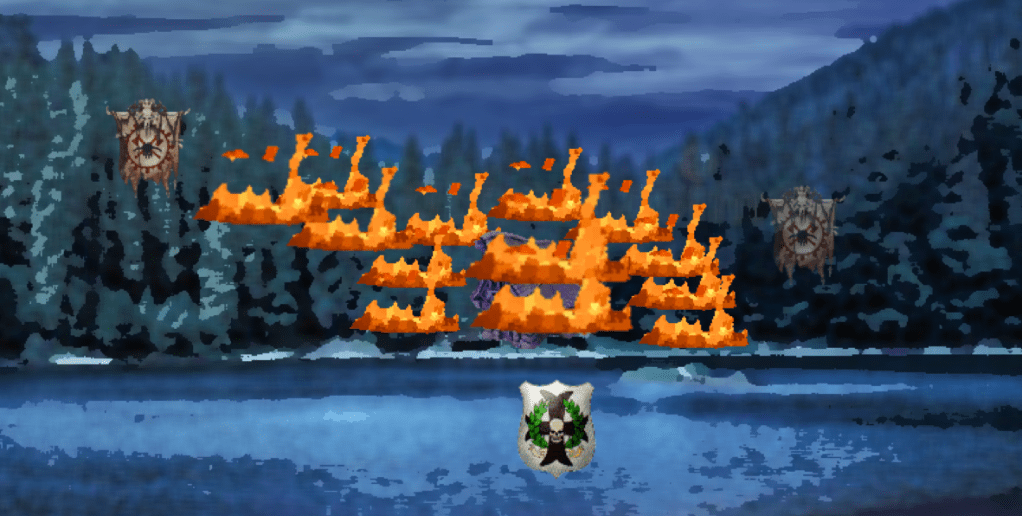
My trap worked (combined with the other defenses) and the larger force of beastmen were caught in my flames, mostly perishing (but taking two halberdiers and a zweinhander man with them).
Another helpful map was shared.
I was feeling quite pleased with myself. I’d used the fire trap effectively and only had to survive for two more turns/hours.
Turn 5
I was concerned about the fire, though I remembered that I had constructed a fire break so my forces should be safe. I decided to put the effort of the turn into pushing back the remaining beastman force using smoke from the fire.
The Forces of the Empire will attempt to prevent injury from smoke inhalation, whilst making the smoke a problem for the remaining beastmen -The Zweinhanders will soak any available robes and tunics with lake-water to act as a mask/filter against smoke -The wizard will use fire magic to push the fires towards the remaining beastmen -The air elemental will push the smoke towards the beastmen. It will extinguish/kill itself with the effort if doing so will help.
Turn 5
The results mentioned that magical agents on both sides were trying to control the fires (the air elemental sacrificed itself in the process). Then the fires broke through and rushed over the hut, killing all the riflemen inside. The remaining forces fled the fire into the water, which writhed with demonic influence causing their skin to itch and crawl. They put damp rags over their mouths to protect from the choking smoke, which may have transmitted some illness in the process. Out in the lake, the wizard surged fire after the beastmen, who fell back. Another, smaller beastman force was revealed. Another map was shared.
When I got the results of the round, I was mildly grumpy. Those pesky emotions.
I had not expected that the fire could spread so quickly over the whole hut area, especially when I was vying for control of the fire too. I felt that the fire going against me was arbitrary, a throw of the dice on which too much had rested.
Let’s examine why that was not true. The beastmen’s goal for that turn was to burn my troops alive, and there was already a fire raging on 3 sides of the hut. Even if I was pushing the left half of the fire towards the beastmen, I wasn’t doing anything with the right half. It was a pretty even toss up between the two, weighted in favour of the beastmen.
Turn 6
So my remaining forces are in the lake water, which is seemingly cursed. I only need to survive another hour until re-enforcements arrive. So I decided to go to the eastern shore and have the wizard use magic to cleanse them all with fresh water. Michael kindly pushed me to suggest more than this, as it would be pretty easy to do and it was the last turn. I reasoned that the forces on the east of the lake must only be a rag-tag group as the main force died in the fire.
The Forces of the Empire leave the lake on the eastern bank and attempt to engage the beastman forces that the wizard sensed there -The Captain will lead the way to inspire his troops -The wizard will cleanse their soaked and probably cursed bodies and clothes by summoning fresh new water once they get on land -The halberdiers will attempt to form a spear wall, with the zweihanders on the flanks
Turn 6
The results ended with a battle, where my survivors fought a shaman, 6 raiders and 20 plague demons. Arrows rained down as a miasmic cloud engulfed the battle. The imperial forces won a pyrrhic victory, and the survivors (the wizard, the captain, a zweinhander and 2 halberdiers) were met by their reinforcements. The beastmen retreat to their camps to fight over who will be their new leader. And finally…
…those surviving men of the empire died of some rotting, delirious fever several days later after setting foot into that diseased lake….
Those pesky emotions again – I was quite grumpy at this.
My emotional reasoning ran thus. The surviving imperial forces had died due to the curse on the lake, which had happened in turn 2. They had been forced into the lake due to the arbitrary decision that the fire had consumed the hut on turn 5. So really, not matter what I did on turn 6 my soldiers could not have survived. It was a forgone conclusion and a wasted turn.
Of course, the fire-hut ruling wasn’t arbitrary, it was very reasonable. But at this point I still felt it was arbitrary as I hadn’t yet seen how decent a ruling it was.
And the lake wasn’t just poisoned by the curse on turn 2. The curse on turn 2 was amplified by the scavenging for dead animals that the beastmen had done on turn 1. And the nurglings (summoned demons) had poisoned the lake further when they travelled through it on turn 4. And the beastman player had devoted most of turn 6 to spreading clouds of sickness and defiling the humans with nurglings. And I had instructed the humans to wrap rags soaked in lake-water around their mouths.
So the stacking of plague was quite reasonable. I could have done a variety of things to mitigate it (for instance, praying to the imperial gods – even during the last turn.
Once I read Michael’s post and saw the actual details of the beastmen player’s turn, my emotions turned around.
What next?
I’m interested in seeing how the next matrixhammer goes. I think that there was too much secrecy in this instance, though it all matched the information our factions would have had. As I’ve already said, Michael’s next Matrixhammer will have all arguments completely public. I think this will improve the play-experience, and I look forward to seeing how it goes.
The matrix games discord is here for anyone whose interest has been peaked.
I’ve toyed with a few ideas for matrix games to run myself, most recently I’ve been considering running a game based on The Battle of the Five Armies from The Hobbit.
I wanted to re-read The Fellowship of The Ring, specifically the Council of Elrond chapter, as I’ve been thinking about making a game where the players are at a council. Council of Elrond, Game of Throne’s small council, Congress of Vienna – that kind of thing.
I read the preceding chapter, Many Meetings, so that I would have all the minor context details refreshed. I actually got a lot more out of Many Meetings than The Council of Elrond.
In order of appearance the interesting things were:
…And Elves, Sir! Elves here, and Elves there! Some like kings, terrible and splendid; and some as merry as children.
Sam to Frodo
I found this quite interesting as the merry-ness of some elves doesn’t get represented in wider Tolkienian fantasy (or Tolkien-esque fantasy) nearly as much as the kingly-ness of some elves.
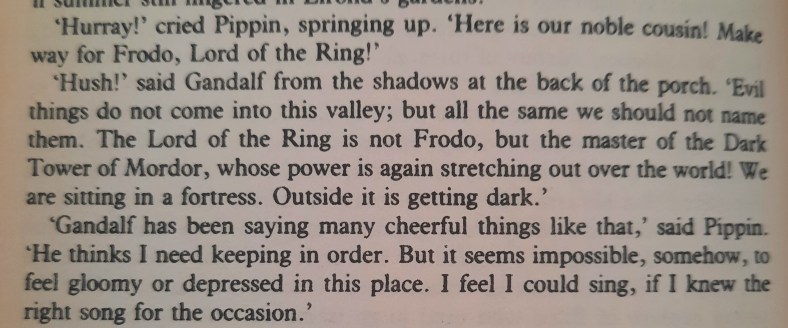
This exchange between Gandalf and Pippin was also excellent, there’s such a strong sense of character here.
It reminded me of all those jokes about campaigns which want to be LOTR but end up as Monty Python – there’s a vast gulf between the two, but there’s space for humour and playfulness in LOTR.
At one point, Bilbo is struggling with some song lyrics that Elrond has insisted must be finished before the evening’s gathering, and asks after Aragorn to help him. This is apparently a habit of theirs. I really like this detail and it’s one of many that occur at this part of the book, as Aragorn transitions from Just Some Ranger to The Heir of Isildur.
The song that Bilbo writes is about Eärendil the mariner. The song reveals that he was an elf from long ago who was a traveler, and that he was entwined with the Silmarils and the Valar. There’s a lot in there, but the bit that really struck me is that the Valar make a sky ship for him from mithril and elven-glass. And that he became a star. This reminds me somewhat of Ramandu, a character in The Voyage of the Dawn Treader who is a star who hangs out on an island. It also makes me think about how pedestrian some of the Tolkien-esque media is compared to the actual legendarium. Edit: my point here is that Tolkien’s works are presented generally within quite strict and mundane parameters, which his actual works don’t adhere to. Another striking bit was that Eärendil’s wife takes the form of a bird to fly with him.
In the next chapter, Elrond reveals that Eärendil is his father. Aragorn talks of the cheek of Bilbo to make a song about Eärendil in Elrond’s house, but Elrond encourages Bilbo. I think Elrond was very pleased with Bilbo’s song, not least because the other elves wanted Bilbo to recite it again, but because of the next passage which I found interesting. (Oh and remember that phial that Galadriel gives Frodo, the one of shining light, that is used to fight of Shelob? It is the light of Eärendil’s star.)
Bilbo and Frodo want to leave the singing in Elrond’s hall to go and have some quiet talk. Bilbo says:
It is difficult to keep awake here, until you get used to it. Not that hobbits would ever acquire quite the elvish appetite for music and poetry and tales. They seem to like them as much as food, or more.
At first I misread this to mean that Elves take their sustenance as much from music etc. as from food, which would be really interesting, but that’s not really the point of this passage. This passage is telling us a lot about both Hobbit culture and Elven culture in one swoop.
Bilbo notes that the Elves really like music and poetry and tales. From Bilbo’s perspective, they like them as much as food or more. This is a very odd comparison for a human to make – imagine someone saying ‘I like TV as much as I like bagels’. It’d be odd for a human to compare entertainment with food in such a way, they are on two different scales.
But its not odd for a Hobbit to make such a comparison because of how much Hobbits like food. The best way for Bilbo to make Frodo understand how much the Elves like music is to compare it to how much they both like food. And this is coming from a Hobbit who regularly writes songs, and has more than one ‘favourite bath-song’.
The only thing of note from the chapter Council of Elrond was that there is much less interpersonal drama than in the movies, particularly surrounding Boromir. He and Aragorn come up with a plan to re-forge the shards of Narsil and ride together to Minas Tirith to support its defense.
There is also a line that Gwiahir the Eagle says to Gandalf
I was sent to bare tidings, not burdens
Which pretty definitively puts to bed the ‘fly the ring to Mordor’ argument.
Overall I found lots of little surprises in the small section I read. My measure of ‘What is Tolkienian’ is broader than it was before.
If you liked the mood music by Colin J Rudd, here’s his rendition of the Song of Durin, which I find far more soulful than many of the grander renditions online. He has many more renditions of other Tolkien songs.
(This is part 2 of a 3 part series about designing magic for tabletop roleplaying games. Part 1 is available here.)
Once again I’ll be referencing Harry Potter a lot, as well as D&D 5e. Harry Potter remains the best cultural touchstone when discussing learning magic, whilst D&D 5e is the big ttrpg.
When I refer to casting magic, I mean the actual things that the character does to make the magic happen, not the results of the magic.
Magic can serve lots of purposes in a fiction. In Lovecraftian fiction it is dangerous and dark, something to be feared and avoided. In Harry Potter it is largely whimsical and a time-saving tool. In Mistborn (I recently read the first book and really enjoyed it) magic is a mechanical tool, mostly of oppression. You get the idea.
The the casting of the magic should reflect and support its themes within the fiction. Generally, it does.
Casting of Lovecraftian magic is esoteric. Casting is likely to involve strange words and dark rituals. Lovecraftian magic is very tightly themed.
Mistborn’s magic is mechanical – ingest the appropriate metal and then use it as mana for that branch of magic. Appropriate for a tool-like magic.
Harry Potter’s magic falls down here (with one big exception). Most magic involves pointing a wand and saying some pseudo-latin. This is somewhat whimsical but it’s core flaw is that it is boring. I’ve written at length before about the three best spells in Harry Potter and the best spell, Expecto Patronum, bucks this trend.
Expecto Patronum creates a glowing magical creature which brings warmth and happiness, and defeats the dark monsters which stand in for depression. To cast Expecto Patronum, the caster must bring to mind a powerful happy memory. This is great theming and moreover it is interesting, not just from a fictional position but from a ttrpg perspective.
Expecto Patronum is essentially acting like a storygame prompt. If a player were to cast the spell, they would need to explain their character’s happy memory to the rest of the players. The casting mechanism is engaging as it is directly supporting narrative development by the players.
This doesn’t directly support the whimsy of the setting, but the glowing animal companion bit does. And this spell is only relevant when depression-monsters are attacking – the darkness to which the whimsy is juxtaposed anyway.
It’s probably not worthwhile to make every spell this engaging in a game like D&D. I don’t want to have to improvise a new memory every time I cast magic missile, and I certainly don’t want my combats to be dragged out even longer than they already are.
In Critical Role, players describe how they character does their attack when the get a killing blow. Reserving engaging questions only for important moments (first time used, fight-ending moments, narratively crucial decision points) would be a good workaround.
It’s hard to provide a formula for making spell-casting more engaging, as it’s very dependent on themes and individual spells. But it is worth considering.
How I’ve made casting the magic in Welcome to Camp Merlin more engaging
I can broadly categorise my approach in three groups: positioning; character prompts; and telegraphing.
Positioning
Shape Shift: Position your body so that your limbs are in the shape of the animal which you wish to become. Hold that shape for six seconds.
It’s not a strict ‘unable to cast in combat’ restriction, but it means the players will have to create the time and space to make the shape. If the player can also pose to show the shape their character for added whimsy.
Character Prompts
Truth Food (food that makes the eater tell the truth): Whilst preparing food for consumption, speak aloud a truth that you have never told anybody.
This is a storygame-esque prompt, like the happy memory for expecto patronum. It also serves as a soft restriction depending on whether the character is around other people.
Telegraphing
Sense Mind (locate nearby minds): Close your eyes, calm your body, and empty your mind of all thoughts.
Any other magic user can infer what magic you are doing by looking at you. In this instance, it also makes you vulnerable, so it’s a risky move in a game of cat-and-mouse.









 Coppers and Boars