Cosmos 2250 – Common non-human species

Part 1 Introduction
Part 2 Common non-human species
Part 3 will be about Technology in 2250

Humanity has encountered a lot of alien species since it first travelled to other worlds. The four most common species are chronicled below broadly from the most relevant to least relevant. Alien species can be broadly divided into the Human-esque and the Weird.

The Human-esque generally act in a similar way to humans but they will have one or more notable differences. They are generally bipedal and around human size, capable of producing human-like vocalisations and with the same range of sensory inputs as humans. In a TV show they would have prosthetics on their heads. Their stories primarily concern culture and ethics. All the species detailed below are Human-esque.

The Weird are truly alien species. For instance, giant spiders which communicate exclusively via vibration, semaphore and pheromone. Communication is difficult, and comprehension sometimes impossible. In TV shows they would be puppets (or CGI, but puppets always age better). Their stories are more fundamental, concerned primarily with the nature of existence and experience.

Orangu

The Orangu are genetically uplifted Orangutans. They are kind, naive and curious.

About 50 years ago, it was discovered that a rogue group of scientists on a far flung human zoological colony had repeatedly experimented on captive mammalian species, endeavouring to create a new sentient species. Only one new species was viable – the Orangu, a modified Orangutan with broadened intellectual capacity, edited vocal cords and a more humanoid gait.

First Generation Orangu are the immediate results of the scientific experiments. They experienced well-intentioned but definitively immoral enslavement by their creators. Second Generation Orangu is somewhat improperly used to describe any Orangu which is not First Generation. They were born into freedom, but often grew up in curated and sheltered environments.

Orangu have a young and unstoried culture, which they see as both a blessing and a curse. The kind-nature of Orangu has made them well-liked by Humans. They are few in number but their curiosity drives them to explore and engage with the world around them. The Orangu cast Humanity in a new light, which caused the creation of The Charter of the Rights of Persons, a total rewrite of the much-amended ancient Declaration of Human Rights.

Orangu names are incredibly varied, as they have no longstanding cultural traditions of their own to draw from.

  • Jupiter Armstrong
  • Charlton Heston
  • Wendigo Frustum
  • Suriawati

Thaveen

The Thaveen are earnest, enthusiastic and obsessive. 

The Thaveen are a human-esque species with wrinkled earth-toned skin and drooping ears. Adolescent Thaveen sample from as broad a range of experiences as possible. Their adulthood begins the moment they find and declare their one true passion. They rename themselves, creating for themselves their proper, adult name. They throw their heart and soul into their passion, obsessively. When a Thaveen hears about someone else’s passions or interests, they engage heartily and encourage earnestly. For a Thaveen, the purpose of life is the pursuit of your passion.

The Thaveen Mandate is run by the Admins, Thaveen who have a passion for organisation, politics and bureaucracy. Thaveen society progressed rapidly from the moment agriculture was invented, due to the guiding hand of the Admins. They had writing before metalworking, a world government before industrialisation, and had eliminated poverty before inventing digital technology.

The Thaveen Mandate have managed an outreach and research programme on Earth for over a generation. By sharing and guiding, they have contributed immensely to recent technological developments on Earth, in particular the development of the R-3 Relativity Drive. They are the closest that humanity has to a friend, but they are not military allies with the League. Earth is too far away, too technologically inferior, and too inexperienced. However, Thaveen officers are routinely found on Space Force starships.

Thaveen names start with a title, essentially a job description, followed by the name chosen by the individual upon attaining adulthood.

  • Admin Soaring Paperwork
  • Doctor Think and Thought
  • Engineer Crash Crash Bang
  • Sergeant Shoots First Shoots Later

The Legion

The Legion are a clone society that is an offshoot of the Thaveen. They are conformist, self-obsessed and grouchy.

A highly-irritable Thaveen geneticist called Legion Discrete dedicated his life to creating clones of himself so that he could enjoy communal activities without the bother of his fellow Thaveen’s quirks and idiosyncracies. He sequestered himself away on an isolated world and he was forgotten by Thaveen society, remembered only as a former eccentric colleague or dance partner.

A century later the Thaveen discovered that Legion Discrete had been successful, and a society of clones, called The Legion, had multiplied and flourished. Despite their shared cultural and technological history, the Thaveen and The Legion only have a cordial relationship. The Thaveen view The Legion as completely missing the purpose of life, and The Legion just think the Thaveen are annoying.

The Legion have exemplary genetic and cloning technology, but hire out to other societies to fulfil many of their needs. They have a very culturally regimented lifestyle. Everyone looks the same, enjoys the same food, is annoyed by the same habits and loves line dancing.

Legion names follow a variant of Thaveen naming convention, where first names are all Legion.

  • Legion Prime
  • Legion Isotope
  • Legion Foot First
  • Legion Stepback

Krix-ik

Krix-ik are a eusocial insectoid species with a caste system. They are mentally rigid and collectivist.

Krix-ik are divided into castes, where each caste has a unique morphology, and serves the colony in a specific manner. The Royal Caste are the only reproductively active Krix-ik and wield unchallenged executive authority – they have never been seen by humans. The Warrior Caste are aggressive and competitive. The Worker Caste are hardworking and deferential. The Thinking Caste, whilst more mentally flexible than the others, are coldly calculating.

All Krix-ik belong to a colony, which can span multiple sites across many star systems. The K’lok ‘ok colony has developed positive relations with the League of United Worlds, including trade agreements, a non-aggression pact and an officer-exchange program. Relations with other colonies are not as positive, and whilst apathy and mercurial interest are common, outright hostility is always a distinct possibility.

Krix-ik culture emphasises the good of the colony over individual outcomes, or even survival. Their culture is almost unrecognisable, consisting mostly of factual storytelling and parables, with no humour or romanticism. As their primary methods of communication are pheromones and stridulations, specialist equipment is generally needed for real-time conversations with humans. All Krik-ik know at least three languages: the common language; their caste language; and their colony language. Krix-ik have a lower level of neuroplasticity than most intelligent species and thus find it difficult to adapt their thinking.

Krix-ik names are poorly rendered in latin characters, not least as it is impossible to spell pheromones. 

  • Vit Vit Ixy Hox
  • Ruxix k’a-it
  • Vot On
  • Raxikix ilk

Cosmos 2250 – Introduction

Part 1 Introduction
Part 2 Common non-human species
Part 3 will be about Technology in 2250

Cosmos 2250 is a science fiction game where players take on the roles of senior officers on board a starship.

This is a game in three parts: Setting, Systems and Scenarios.

  • Setting details known information about the world and is designed to orient any players of the game and align expectations.
  • Systems is a series of frameworks and procedures intended to aid in aligning expectations and understanding within the game group.
  • Scenarios relates the specific situations that the players will encounter.

Tone and Genre

This game has a positive view of the future of humanity. It is a future in which humanity has overcome great adversity and become a better version of itself. A future where humanity has an active ongoing effort to be the best version of itself.

This game is in the science fiction genre. It is full of alien cultures, strange technologies and philosophical dilemmas. Their purpose is to hold a mirror up to ourselves. They exist to create a shared narrative, and in doing so, examine what it is to be human. And they also exist because starships, aliens and laser guns are cool.

This game contains politics, diplomacy and elements of realpolitik. The players must balance their respect for other forms of life with the need to ensure their survival.

Humanity from 2000 – 2250

Humanity was facing a climate crisis, and failing to deal with it.
Technological progress did not help. In fact, it was the cause of the crisis.
Social innovation saved Earth’s inhabitants from themselves. From the worst of themselves.

A practical, viable, sustainable future was reached. 
Humanity proved to itself that it can achieve long lasting, positive global change.
And it didn’t stop there.

Humanity eliminated poverty in a generation.
Turned its focus on education for the next generation.
And then it reaped the rewards of an educated population whose basic needs were satisfied.

Nuclear Fusion came next.
And the reality-warping Relativity Matrix, the ticket to the stars.
And then we met everyone else, and they met us.

Welcome to the Galaxy.

The League of Worlds in 2250

The League of Worlds is effectively the ‘space government’. Its primary purpose is to provide peace, safety and prosperity for its members, and as such it is responsible for all the normal governmental things: diplomacy; trade; immigration etc. However, individual planets, moons, space stations and so on all have their own polities and governments, which in turn have their own laws. Sometimes astronomical bodies are further subdivided into countries, as on Earth.

Matters of jurisdiction and legal precedence can therefore become rather complicated. There is a Court of the Rights of Persons, administered directly by the League, which acts as an ultimate arbiter on issues of individual rights amongst its members.

Most persons within the League are Human, and most of the population lives on Earth. There are large colonies on other planets in the Sol System and nearby systems such as Alpha Centauri and Tau Ceti. The further one travels from Earth, the colonies become less common and less populous. Orangu and Thaveen (including Legionaries) make up the vast majority of the non-human population within the League. The League has an active policy of fostering positive relations with other species, and there are a handful of associate members, which it hopes in time will gain full membership.

The League operates and maintains the Space Force, which it characterises as a ‘uniformed exploration and defense service’. The Space Force has many of the hallmarks of the militaries of old-Earth, and maintains high standards of professionalism and duty. However, it is not, first and foremost, a military. The Space Force has three core standing duties:

  • Aid those in need
  • Discover the undiscovered
  • Advance the League

Laser Monks in Outer Space is released! Free on itch!

Laser Monks is an ultralight tabletop roleplaying game where you play as space-paladins with Laserblades and superpowers.

The core of the game is about adhering too, or rejecting, the Laser Monk creed, known as The Path.

The Path is Peace

The Path is Compassion

The Path is Moderation

You can get it for free on itch.io by clicking the image below.

https://kingbim.itch.io/laser-monks-in-outer-space

I made Laser Monks for the Ultralight Game Jam, which had two design rules:

  • the game’s rules can fit on four or less pages in an A5 format
  • the game uses a single dice type for all resolution mechanics

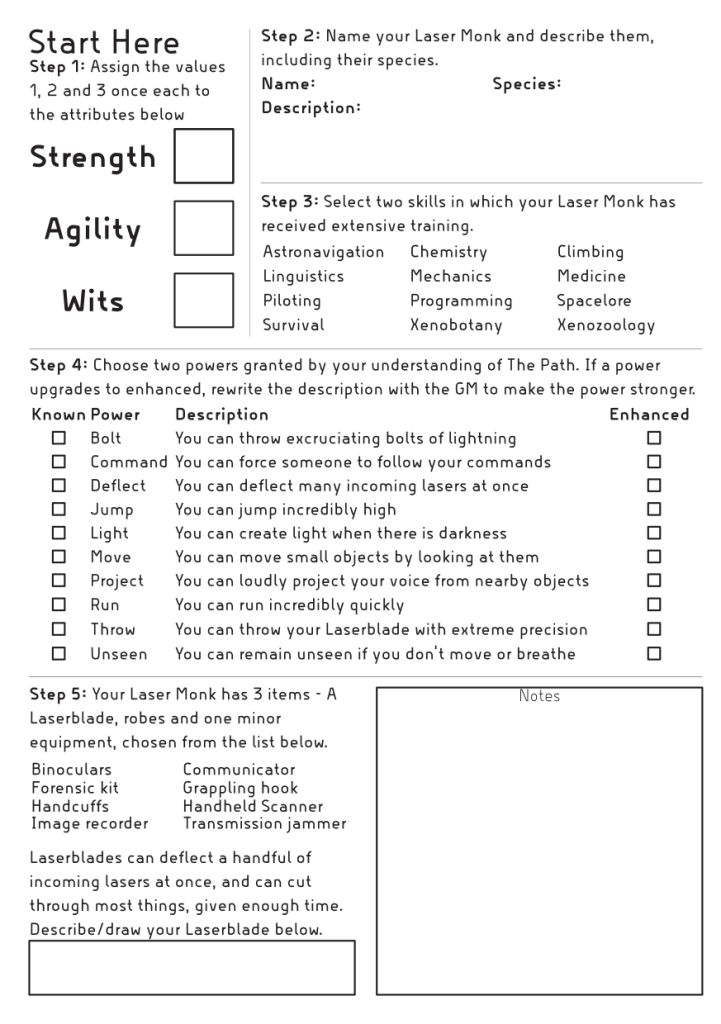
I interpreted these restrictions even more tightly, and decided that the rules, including the character sheet and character creation, were going to fit on 4 pages of A5. The game has a simple dice pool system and only uses D6 dice.

The left half of the character sheet, which includes the character creation rules. The right half, not pictured, has advancement and injury rules and the space to track them.

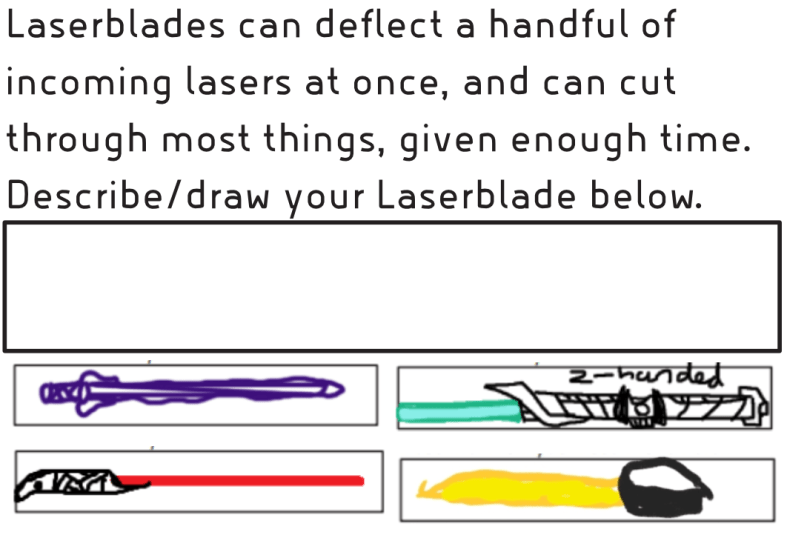
During playtesting, the players had fun with the ‘draw your Laserblade’ rules.

There is no mechanical effect, it’s just kinda neat

Laser Monks also includes an easy-to-run setting. I think it would take a GM about 15 minutes to read the setting and prepare a game session from it.

And I released the whole game under a CC BY-NC-SA 4.0 license (except the front cover items).

If you play a session, let me know how it went via my twitter or in the comments here.

There is no light side of the Force

In the original Star Wars trilogy, and in the Prequel trilogy, there are no direct references to a light side of the Force.

The dark side is mentioned once in A New Hope, and several times in Empire Strikes Back and Return of the Jedi.

The closest we get is in Empire when Luke asks Yoda:

But how am I to know the good side from the bad?

The Prequel trilogy also has several references to a prophecy that states that Anikan will ‘bring balance to the force’.

But even though the dark side is explicitly referred to, there are no direct references to the light side.

The Sequel trilogy breaks with this.

Han refers to ‘the dark side and the light’. Kylo Ren says he feels a ‘pull to the light’. Maz tells Rey that the feeling of the light has always been there. Leia tells Han that there is still light in Kylo Ren. The Force Awakens’ trailer also mentions ‘the dark side and the light‘.

But if we ignore the mess that is VII-IX, and if we ignore the countless references to the light side of the force in video games, novels etc. then we reach a reasonable conclusion.

There is no light side of the Force.

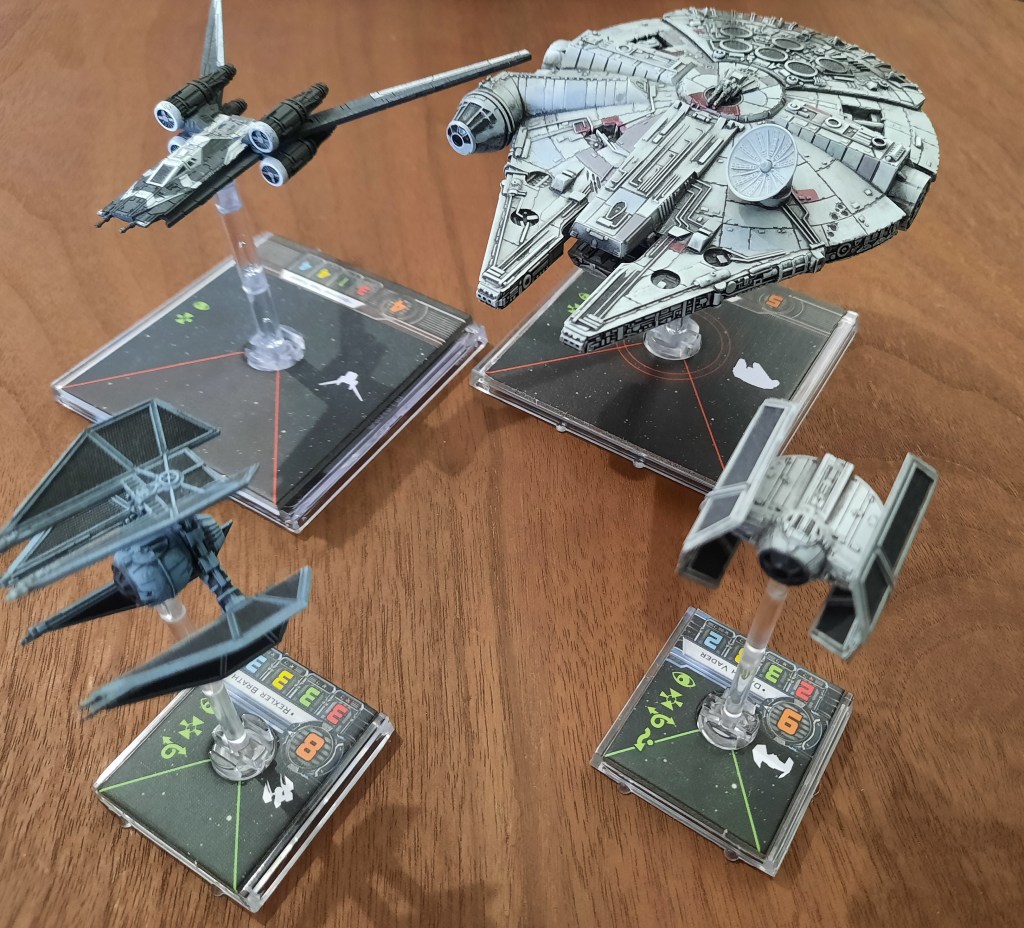
Part of my mournfully under-used x-wing miniatures collection.

How can there be a dark side and not be a light side?

The original alignment system in D&D was threefold

  • Lawful
  • Neutral
  • Chaotic

From the release of Basic D&D in 1977 (the same year that the first Star Wars movie was released), a two-axis system was preferred. Characters still fell on the lawful-chaotic axis, but now fell on another three part axis

  • Good
  • Neutral
  • Evil

Combining them leads inexorably to these alignment chart memes

I’m lawful good, but if the breadbin is full I resort to chaotic neutral.

I propose that the Star Wars Force alignment chart should look like this:

  • The light side of the Force
  • The Force
  • The dark side of the Force

The Force occupies a position of neutrality, maybe even true-neutral in dndspeak. This matches with the dialogue in movies I-VI and also fits with the way that the Jedi act in the prequel movies. Their dogma and rules get in the way of their ability to do good. And it fits with the idea that Anikan’s love (for his mother, and later for Padme) leads him to the dark side.

And, like rhyming poetry, it fits the ideas from Return of the Jedi, where the Emperor wants Luke to strike his enemies down. He wants him to stray from the neutral path of the Jedi. Killing in anger, even killing someone who has done bad things, really bad things, is not the Jedi way. Luke argues with Yoda in Empire – Good Luke wants to go and save his friends, even if it is a trap, whereas Neutral Yoda believes that fear-of-loss is a path to the dark side. In fact he told Anikan as much in Phantom Menace.

The challenging part of the ‘no-light-side’ interpretation of the Force is that it feels skewed and off-balance. We expect there to be a good/evil dichotomy (maybe with neutral in the middle).

I’m fine with that.

But what does that mean for D&D alignment?

What would a setting look like if it was devoid of certain cosmic alignments? Or if there were no Good deities? Or no Lawful ones?

Sidenote: The best alignment system

The Magic: The Gathering colour pie is the best alignment system.

In fact, excellent settings have been built just from tinkering with the colour combinations.

Ravnica is fuelled by this

What does an organisation look like if it is red/green? A wild clan obsessed with raw and primal nature.

A green/blue organisation? Biomancers, playing God whilst creating hybrids and mutants.

Green/black? A death cult living in the sewers, fungus and necromancy and questionable food for the masses.

And so on.

Truncating the Calendar Year like in Stardew Valley

I want my game to be epic, spanning many years, with the potential for characters to grow old; for new generations to come to the fore and take up the mantle; and for nations to rise and fall.

Problem: Even with a game/system which is well designed for that kind of long-term view, everything takes about 2 to 4 times longer than I expected to play out.

Untested potential solution I have not seen touted before: Truncate the calendar year down to 112 days. (This could also serve as a worldbuilding spark.)

Stardew Valley

Stardew Valley is a Harvest Moon-like video game where you have run cute, artisanal farm. As its a farming game it wants the seasons to change so crops can rotate and you can experience the bountiful summer and fallow winter. However, it doesn’t want you to have to play out about 90 in-game days for the season to shift. That would be tedious.

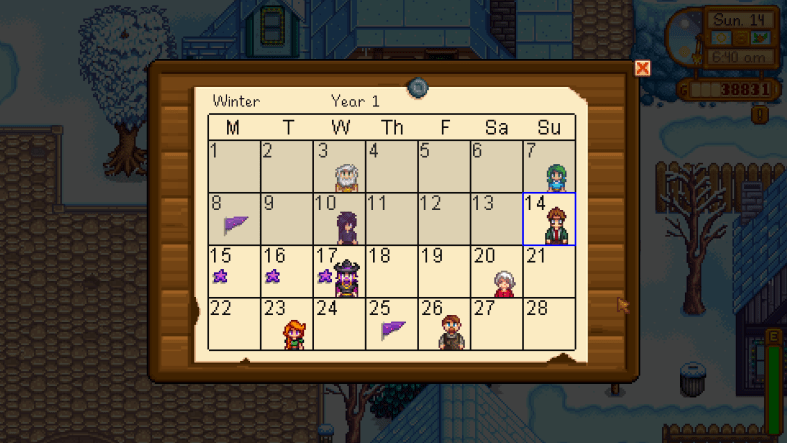
Instead it uses a 28-day season. Four weeks of 7 days makes up a season. There are four seasons – Spring, Summer, Autumn, Winter.

If my fantasy game is in a secondary world (not Earth), then I could truncate the world to have 4 seasons of 28 days – a 112 day year.

This would roughly third the number of days in the year, which is convenient since games take about 3 times longer than intended to play out.

Stardew Valley’s calendar, Winter edition

How to manage a truncated year

We need to change the durations of everything in the setting to fit our new 112 day year.

  • Events on the day-scale should still take roughly the same number of days as usual
    • Cows can be milked once per day
    • You eat three meals a day
    • You can walk about 3 miles per hour for about 8 hours without exhausting yourself (though you will still be tired)
    • Chickens lay eggs every couple of days
  • Events on the year-scale should take roughly the same fraction of a year as usual
    • Human pregnancies last for about 3/4 of a year (roughly 3 seasons or 84 days)
    • Humans legally become adults after 18 years
    • Lambs are born in the Spring

There are some events whose new durations will have to be chosen by you (as a game-master or as a table of players). Everything in your game is levers, and you need to decide which setting these levers are on.

  • Does health and illnesses resolve on the day or year scale?
    • Year-scale means quicker healing but quicker deterioration times when unwell or injured.
  • Do weather phenomena change on the day or year scale?
    • Year-scale means volatile sudden rains and storms. However, day-scale means a dry spell or cold-snap could have a massive destabilising effect on the crop growth of that year, as there is a smaller band of days to plant and harvest within.
  • Are settlements 3 times closer together than normal?
    • A 30 day round trip takes a whole season now (rather than a third of a season).
    • Closer settlements facilitates better trade and a more in-contact world, with closer cultural ties. It also increases the ability for centres of power to project their influence (though tax collectors and military patrols)
  • Does learning occur at the day-scale or year-scale?
    • Year-scale means skills and knowledge will match our expectations for the age of a character. However it will mean that learners progress more quickly day-to-day, probably though improved memory/retention or through increased rates of comprehension.
    • Day-scale means that everyone learns at the same rate, but it takes longer to build up a knowledge base.

There are so many areas to consider that you would probably have to discuss them a the table as they arose.

A rule of thumb is that day-scale results in a grittier game and year-scale in a more epic game.

What’s the use of this?

  • A thought experiment to help you think about how parts of your game are connected to time (and each other)
  • A worldbuilding spark (ask yourself “if this is true, what else is true?”)
  • A sci-fi world (take this idea and stick it in your traveller/star trek game).
  • A design principle. Just as DMs have talked about attacking every part of the character sheet, worldbuilders and game designers should challenge every assumption of the setting.

This is part 1 in a loose series I’m awkwardly calling ‘like in’ where I take some trick from video games and apply it to tabletop games. Part 1 is about Dealing with single character death like in Heroes of Hammerwatch

Space travel procedure + random space encounters

Accidental review of Star Trek Adventures

I’ve run Star Trek Adventures a couple of times now. Its core system is feels like a bespoke mechanism for treknobabble and dealing with sci-fi problems, which is pretty much exactly what I need for a trek game.

It’s space combat system feels like playing FTL: Faster Than Light, where either you wipe your enemies or you engage in a manic struggle for survival. The ground combat system is similar, but without the threat of ejection into the void or a warp-core breach.

It’s relatively difficult to find the information you need when running the game, so much so that I created this google slides doc to ease the running of combat when I was prepping my second campaign. Even then, combat took a while.

The game also has a great online character generator.

The characters pick several beliefs and then receive meta-currency for engaging with them. I struggled to make that work in my games, just as I struggled with Burning Wheel‘s meta-currencies and belief system.

Star Trek Adventures has lots of material about the federation and trek-stuff in general, and I wonder what it’s for. I assume most people buying the core book know a reasonable amount about Trek already or they wouldn’t be buying it. But if you didn’t know much about Trek, the best way to find out is to watch a few episodes or movies, not read a dusty tome.

There is even a series of missions available for free on their website which I used when I was getting started. TOS and TNG eras supported.

The biggest problem I had was with a total lack of procedural tools. The game assumes you’re playing in an episodic fashion and provides no support for a sandbox. And I wanted to run a sandbox.

So I made up a space travel procedure. Below is a modified version based on what did and did not work.

Optional musical theme for this post. I used to play it at the start of every session. In the second campaign I ran I used the opening and closing credits from The Orville.

Sagittarius, by Sidney Hall and Richard Rouse Bloxam

Actual Space Travel Procedure

I’m assuming the use of a hexmap, and that each hex corresponds to a star system. Hexes can also be empty, and there are space features which span several hexes such as nebulae.

Your ship has two main actions when travelling: Scanning and Moving.

When your ship Scans, choose one option from below

  • Detailed Scan: receive detailed sensor information on any one adjacent hex (the star’s class; along with an estimate of how many space ships or other constructed space entities there are; and how many planetary bodies there are, divided into small (roughly Earth sized and smaller) and large (ice giants and gas giants))
  • Rudimentary Stellar Scan: receive sensor information about two adjacent hexes. Rudimentary sensor information just gives the class of the star (if there is one).
  • Detailed FLT trail Scan: receive detailed information about faster-than-light trails in any one adjacent hex. This might detail the number and direction of any trails, and information about the size and speed of those ships. The information may be up to a week old.
  • Rudimentary FTL trail Scan: receive information about faster-than-light trails in any two adjacent hexes. This is just an estimate of number and direction, and only pertaining to travel from the last day or so.

When you Scan you should make some sort of roll or check that will determine the quantity of information revealed.

When your ship Moves you go from your current hex to an adjacent one. Choose one option from below

  • Cruise: Travel at your ship’s standard speed. You can Move to one adjacent hex
  • Sneak: Travel at half your ship’s standard speed. You can Move half of a hex’s length and it is much harder for you to be spotted by FTL trail scans (get advantage or something)

Each day your ship can choose two actions from the above list.

  • If your ship will Cruise twice, you can go an additional hex. This is called Maximum FTL. Sustaining Maximum FTL for more than one day will require an engineering check.
  • If your ship will Scan twice, then you can scan not only adjacent hexes, but also hexes adjacent to those (ie not only the nearest 6 hexes but also the 12 hexes surrounding that.
  • Your ship can also spend its actions repairing but that is probably too system-specific to get into here.
Infrared image of the Andromeda Galaxy

Random Space Encounters

I would use a hexmap that’s about 10×10 with star systems no further than 4 hexes from each other.

Once per dey, roll on the Initial Encounter table. If you get an encounter as the result then also roll Complication table.

d6Initial EncounterComplication
1Interior EncounterInterior Encounter
2AnomalyInterior Encounter
3Exterior EncounterExterior Encounter
4No encounterExterior Encounter
5 No encounter No encounter
6No encounterNo encounter

If you want to have less encounters, keep the table the same but use a larger dice (d8/d10) and make all results above 6 result in ‘No encounter’.

If you want to have more encounters, roll for an initial encounter twice per day instead of once.

d6Anomaly
1A ripple in space-time: ship’s dog Rover is replaced with a cat from the mirror universe that acts like a dog, answers to the name Rover.
2Beachball sized orb follows the ship: Whoever looks at it sees a minaturised version of their homeworld.
3Ion storm causes a momentary lapse in holodeck safety protocols: A historical figure from a holodeck program is made material and sentient.
4Gaseous mind-parasite sneaks in through an exhaust port and infiltrates replicators: Crew’s food becomes hallucinogenic.
5A rapaciously hungry tar-like blob attaches itself to the hull causing minor damage: It will grow and devour the whole ship if left to itself. It is psychic and is very open about its desire to consume the entire universe.
6Wormhole: Takes the crew back to stone-age earth where aliens are trying to mess up the future. The wormhole will collapse in 3 hours.

As I used up events on the Interior Encounter table below, I added more events based on the actions of the party. These are intended to mostly be short social encounters which emulate day-to-day life on the ship.

d12Interior Encounter
1Cultural celebration for one of the less prominent species/cultures on the ship
2Ship’s pilot is challenged to a simulation race
3Physical poetry recital
4Barcrawl of 20th century pop-culture bars and pubs on the holodeck
53rd grade’s production of the first ever FTL flight – Senior officers are invited to performance
6Safety Drill – how to handle a virulent space-plague
7A live-action production of The Pirates of Penzance by Gilbert and Sullivan, performed by engineering
8An attempt to add obscure alien cuisine to the replicators has succeeded and the crew are invited to Exotic Food Night
9Film night and munchies after
10Chief historian interviews senior crewmembers
11Security Chief puts senior officers through a hand-to-hand combat refresher course
12Judging a contest to name a new species of space-whale
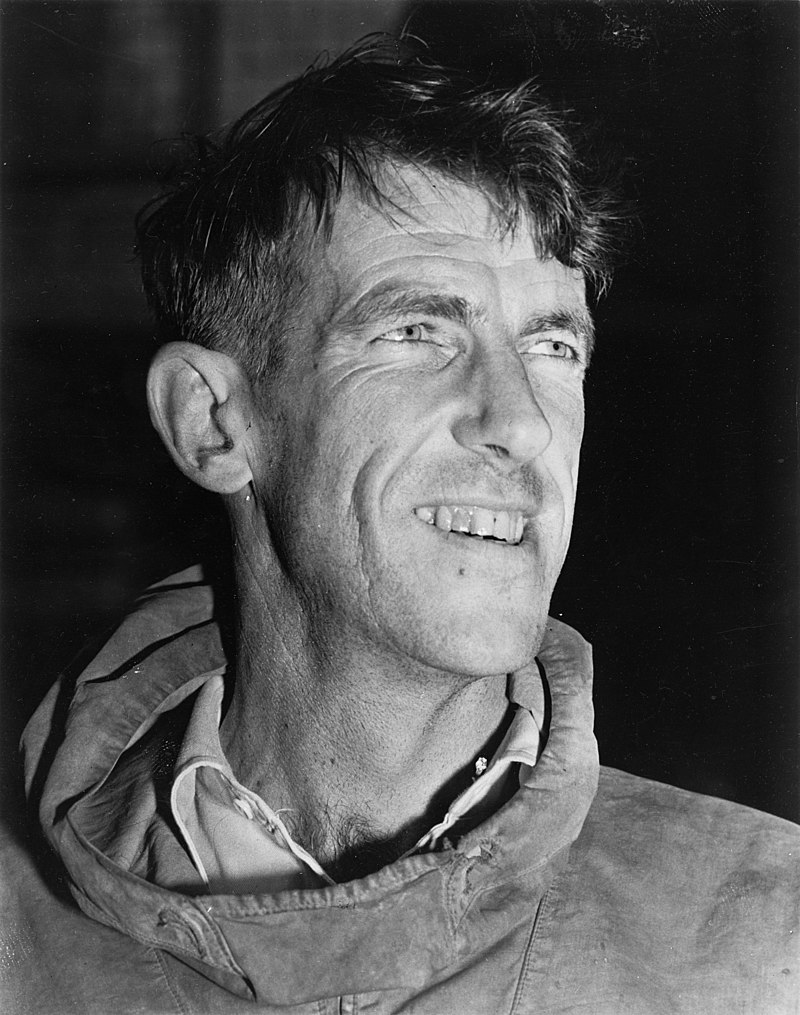
Edmund Hillary, namesake of the ship in my second campaign, the USS Hillary. In my first campaign the ship was the USS Ibn Battuta.

In the Exterior Encounters table below, roll d12 twice: the first result is the encountered ship, whilst the second is the mood/motivation of the ship. You may need to roll another ship to interact with the first one for it to make sense. I took inspiration from the random encounter tables in Hot Springs Islands which are fantastic.

The first 8 entries in the table were universal no matter which part of the hexmap the players were in. The last 4 entries changed depending on which inhabited star system they were nearest to.

Because the actual encounters were so closely related to the setting the players were exploring, I’ve genericised them below.

I also used the table below when players scanned a region of space and wanted information on the ships that were travelling through there (or had recently travelled there).

d12ShipMood/Motivation
1Merchant VesselIn distress
2Pleasure craftRepairing
3Insane raiderPatrolling
4Prospector/Mining shipAid Mission
5Archeological/Geological research vesselHunting/Gathering/Mining
6Astronomical research vesselFleeing/Pursuit
7Mind Vampire Psychological warfare frigateIn Combat
8Peacekeeper patrol cruiserCritical Emergency
9Local Merchant VesselSurveying
10Passenger ShipTrading
11Carrier GroupDiplomatic Mission
12Scout ShipEspionage

It would be perfectly possible to re-order the Mood/Motivation column and use 2d6 instead of a d12, knowing that the middle results will be weighted towards much more than the outer results.

Design Notes

I designed the above system for encounters to make it the game feel like Star Trek TNG. Some great bits of sci-fi happen in the less action/diplomacy centered moments of the show, for instance: Data’s excellent poem about his cat, Spot; Worf discussing Klingon mating rituals; and Picard Day. Moments that let us see the characters in a more relaxed setting, or that illuminate and flesh out elements of their cultures.

In my own game the internal encounter table became radically different as play went on and it was increasingly influenced by past actions of the player characters. We had a simulated paintball deathmatch to settle a point of honour; a fashion show to introduce the new ships uniforms; and holographic Steve Irwin examining the ship’s cat, Rover. Our last session had that characters playing a holonovel where they played as their characters playing characters from Robin Hood. It was very meta, very hammy and a great send-off.

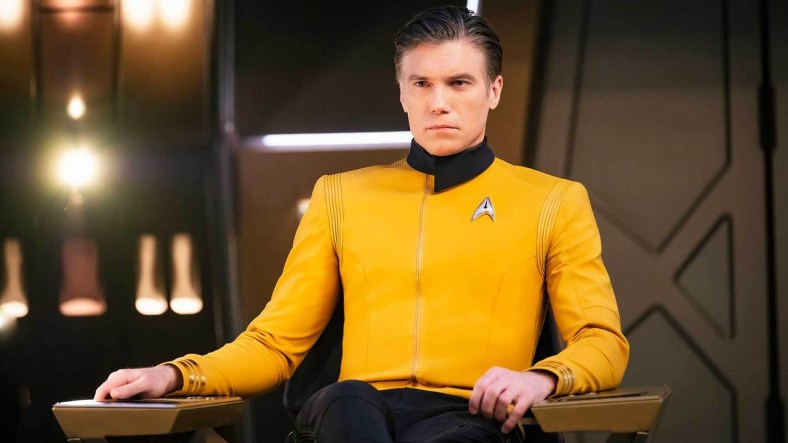
The format of the new ship’s uniforms, and probably the best thing to come out of Discovery Season 2